Players that have a signing bonus on their contract should be paid on July 1 as scheduled, according to ESPN’s Emily Kaplan. More than $300 million are due to go around all 31 teams to pay their players. The Toronto Maple Leafs take the most money from the pot with about $60 million owed. The NHL and NHLPA had come to an agreement on whether or not to pay players Tuesday.
Maple Leafs forwards Auston Matthews and Mitch Marner have the highest pay with $15.2 million and $14.3 million respectively. Connor McDavid of the Edmonton Oilers comes in third with $13 million and Artemiy Panarin of the New York Rangers comes in fourth at $12 million, according to CapFriendly.com
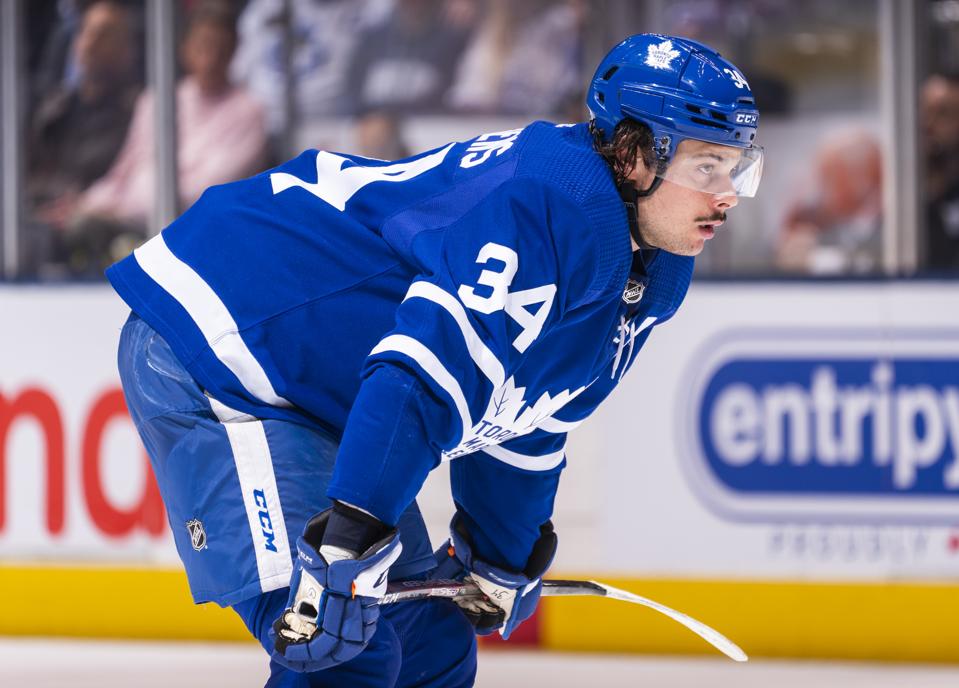
Toronto Maple Leafs forward Auston Matthews is the league’s top player in pay with $15.2 million with teammate Mitch Marner right behind him at $14.3 million. Image courtesy: Mark Blinch
Right now, both sides are in talks about an extension for the collective bargaining agreement. These talks are crucial since the season was paused on March 12 due to the coronavirus pandemic. The NHL and NHLPA have to figure out a way to make up the money they lost within a salary-cap framework and a 50-50 split of hockey-related revenue between the owners and players. A big part of these talks is player escrow and how it affects the 50-50 split of hockey-related revenue.
What is a player escrow? An article written by Jesse Campigotto of CBC Sports goes more into detail about this topic which can be found by clicking here.
Chicago Blackhawks’ captain Jonathon Toews and New York Rangers forward Artemi Panarin aren’t big supporters of the league’s escrow system.
Recently, Panarin took to social media to speak out against the league’s escrow system. “For nearly two decades, the players have protected the owners’ income with escrow, including throughout this pandemic crisis, even as owners’ equity continues to grow exponentially,” Panarin says. “It is time to fix the escrow. We as players cannot report to camp to resume play without already having an agreement in place. We are all in this together.”
— Artemiy Panarin (@artemiypanarin) JUNE 25, 2020
The loss of gate revenues creates a bigger gap between league revenues and player pay. This means that players will only get a smaller percentage of money from escrow. The worst-case scenario is that there’s no money return at all for a player. It’s bad enough that a player has to have a percentage of their check’s taken off.
ESPN reported that the escrow percentage for the next two or three seasons could fall between 20 to 25 percent. This could affect players who have lucrative contracts now or want one in the future. Panarin should be earning $38.5 million from his $67.5 million contract for the next three seasons, according to CapFriendly.com. This means that players won’t get a refund from escrow. According to ESPN, Panarin jokingly said that he would skip the 2020-21 season if the league tried to attempt to do salary cuts like some European soccer leagues proposed.

New York Rangers forward Artemiy Panarin voices his opinion on his frustration with the league’s player escrow through social media. Image courtesy: Frank Franklin II
The current CBA expires in September 2022. Don’t be surprised if there’s a labor dispute with escrow being the main reason why.
There are players that don’t want to come back to play according to Erin Engels of Sportsnet. “One player said a majority of the players do not want to return to play this summer. Estimated 75%.” Engels said on Twitter.
Another player said that calls with the NHLPA have been “a joke” and that they have only revolved around the financial situation. 3/
— Eric Engels (@EricEngels) JUNE 30, 2020
All players I spoke with are frustrated about being kept largely in the dark about how they’ll safely be able to resume play. 5/5
— Eric Engels (@EricEngels) JUNE 30, 2020


Players must be 21 years of age or older or reach the minimum age for gambling in their respective state and located in jurisdictions where online gambling is legal. Please play responsibly. Bet with your head, not over it. If you or someone you know has a gambling problem, and wants help, call or visit: (a) the Council on Compulsive Gambling of New Jersey at 1-800-Gambler or www.800gambler.org; or (b) Gamblers Anonymous at 855-2-CALL-GA or www.gamblersanonymous.org.