With free agency slowing down and the draft still a month away, the NFL offseason has somewhat died down. This “in-between” period is generally headlined by over-hyped college pro days and trade rumors, making the NFL’s annual league meeting somewhat forgotten. All 32 of the league’s met in Orlando this week to discuss possible rule changes. The NFL’s Competition Committee approved seven new playing rules for the 2018 season.
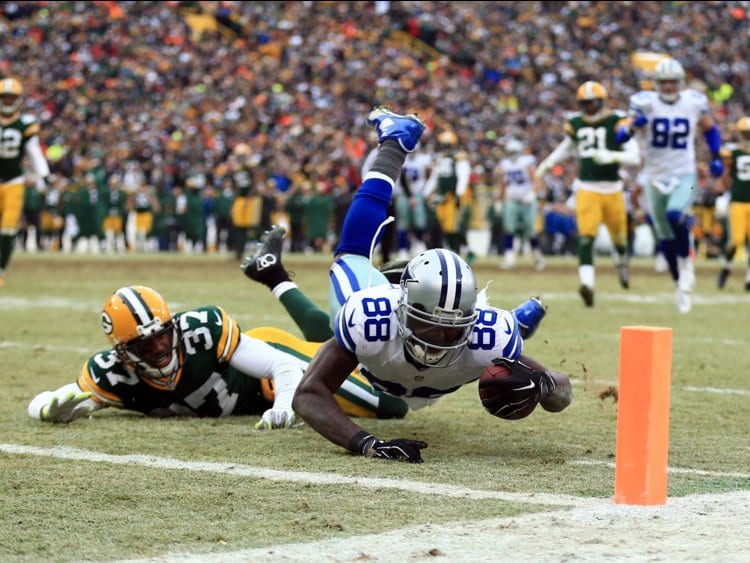
Cowboys receiver Dez Bryant has this catch against the Packers overturned, sparking a debate over what a catch is. Photo by Reuters
After nationwide confusion on what constitutes a catch, the Competition Committee chose to simplify the “Catch Rule”. The new definition states that a player must do three things:
This new definition will ignore the “surviving the ground” nonsense that was prevalent last season. The true definition of a catch quickly became a punchline last season, and the NFL hopes that this new rule will change that. Although the definition of a catch will never be perfect, this does seem to be a step in the right direction.
To reduce the risk of major head injuries, the Competition Committee broadened its rules on helmet-to-helmet contact. The new rule states that any contact led with a player’s helmet will result in a 15-yard penalty. This rule is applicable to any player of any position. The fouled player may also be ejected from the game, depending on the severity of the hit.
Also, regarding ejections, the Competition Committee will now allow a “designated member of the officiating department” to eject a player. This means that the NFL’s New York office will be able to instruct or overrule an in-game referee when an ejection is necessary.

Photo from footballscoop.com
For the previous two seasons, touchbacks from kickoffs have been placed at the 25-yard line. This rule was on a year-long trial basis and will now be the standard starting in 2018.
The NFL Competition Committee believes that moving the touchback to the 25-yard line will limit the number of kick returns, and thus the number of high-speed collisions that may cause injury.
By the NFL’s Competition Committee, the penalties for illegally batting and kicking a loose ball will both be for 10 yards. For most fans that don’t know, illegal batting is hitting a loose ball towards an opponent’s end zone. Illegal kicking is similar, and a loose ball cannot be kicked in any direction. Apparently, these similar fouls resulted in different penalties. Who knew?

After an 8-minute wait, the Minnesota Vikings are finally able to run one meaningless play to end their game against the Saints. Photo by RJ Bell
Prior to this rule change, if a team scored a game-winning touchdown with no time left on the game clock, both teams were forced to remain on the field to attempt an extra point. This has always been a ridiculous rule and was on full display following the “Minnesota Miracle”.
After Stefon Diggs’ career-defining touchdown, it took nearly ten minutes to organize an extra point attempt. It made for a rather awkward pause in the Vikings’ celebration and took away from the game’s viewing experience.
Thankfully, teams will no longer have to remain on the field for this meaningless play.
This rule merely clarifies the procedure following a turnover in overtime. According to the Competition Committee: “In overtime, if the team that possesses the ball first scores a field goal on its initial possession and the second team loses possession by an interception or fumble, the down will be permitted to run to its conclusion, including awarding points scored by either team during the down.” Basically, a game-ending turnover will not be immediately blown dead. If he chooses to do so, the defensive player may return the ball for a touchdown.
Featured image by Phelan M. Ebenhack/AP Images
You can “Like” The Game Haus on Facebook and “Follow” us on Twitter for more sports and esports articles from other great TGH writers along with Kenneth.
“From Our Haus to Yours”


Players must be 21 years of age or older or reach the minimum age for gambling in their respective state and located in jurisdictions where online gambling is legal. Please play responsibly. Bet with your head, not over it. If you or someone you know has a gambling problem, and wants help, call or visit: (a) the Council on Compulsive Gambling of New Jersey at 1-800-Gambler or www.800gambler.org; or (b) Gamblers Anonymous at 855-2-CALL-GA or www.gamblersanonymous.org.