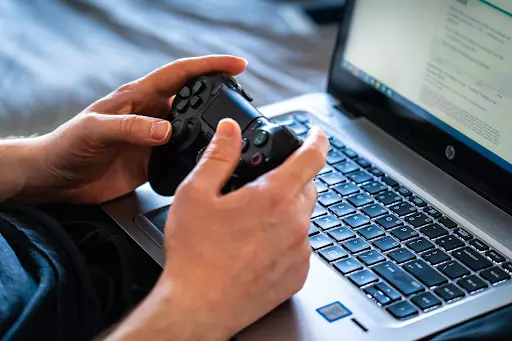
Open an online slot today and you might notice that there are missions to complete, rewards to unlock, animated characters, progress bars and bonus stages that look more at home in a mobile game than on a casino screen. The old image of three spinning reels and a lever doesn’t really describe what developers are making anymore.
This isn’t a coincidence. Casino studios have been watching the video game industry for years, and the exchange goes both ways. Some mechanics have moved between the two almost unnoticed. Others have raised questions about how much influence game design should have over gambling products.
A useful starting point is the work of American psychologist B.F. Skinner. Back in the mid-20th century, his experiments explored how animals responded to different reward patterns. One finding became particularly relevant to game designers: when a reward arrives unpredictably, the behaviour leading up to it can become remarkably persistent. This is known as a variable ratio schedule.
Anyone who’s spent an evening trying to get a rare weapon in an RPG will recognise the pattern. You defeat an enemy, receive an ordinary item and decide to try again. The next attempt could be different. Slot machines operate on a comparable principle, although the stakes are obviously not the same.
The subject also interested anthropologist Natasha Dow Schüll. While researching casinos in Las Vegas, she spent years talking to players and people involved in designing gambling machines. Her 2012 book, Addiction by Design, introduced the term “machine zone” to describe a state in which players become deeply absorbed in the activity. They may lose track of time and pay less attention to the money passing through the machine.
Video game communities tend to use the word flow for a related experience. It’s not quite the same thing, but the resemblance is worth considering. Both game developers and casino designers have an interest in keeping people engaged for longer. What happens when that engagement involves real-money stakes is a rather different matter.
The influence of video games is particularly visible in the mechanics themselves. Consider a few examples.
The presentation has changed, too. Live dealer games are a good example. Evolution’s Crazy Time combines a presenter, bonus wheels and multiplier rounds. The host gives the game a show-like atmosphere, while the visual format feels closer to interactive streaming entertainment than a conventional casino table.
It’s not hard to see why operators put so much effort into their game libraries. Browse the best real money online casinos in Canada and the similarities with mobile entertainment become quite obvious. Game categories, recently released titles and popular picks are all designed to make browsing feel familiar.
Sound effects can shape how players perceive a game, even when the outcome isn’t positive. Psychologist Mark Dixon’s team studied this effect, including “losses disguised as wins”: a player bets 20 cents, gets 15 back and hears celebratory music despite losing five. Near misses have a similar effect. A 2009 study published in Neuron found that they activated reward-related brain regions, including the striatum, in gamblers. Video games use comparable moments, too: a boss survives with almost no health, or a race is lost by a fraction of a second. Either way, the reaction is familiar — one more attempt might be enough. In casino games, however, that impulse can cost real money.
The debate has also reached regulators. In 2018, Belgium ruled that some paid loot boxes could fall under gambling laws. A study of 7,422 gamers published that year also found a link between loot box spending and problem-gambling measures, though it didn’t prove causation. Canada takes a provincial approach: Ontario launched its licensed iGaming market in April 2022, while other provinces have their own rules. That’s why players should check a platform’s licence and local regulations rather than judge it by its games or graphics alone.
Video games and casino products have more in common than their different reputations might suggest. Both rely on carefully designed interfaces, reward systems and audiovisual feedback. Some of these ideas make games more entertaining; others deserve closer scrutiny, particularly when real money is involved.
The interesting part is that players don’t necessarily notice where one design tradition ends and another begins. A progress bar feels familiar, a bonus round looks like a mini-game, and a familiar sound signals that something good has happened. These details can make a slot feel less like a traditional gambling product.
Still, knowing how a game is put together changes the way it’s experienced. A near miss is still a loss. A celebratory animation doesn’t change the balance. And another round isn’t automatically worth playing just because the previous one ended almost in a win.


Players must be 21 years of age or older or reach the minimum age for gambling in their respective state and located in jurisdictions where online gambling is legal. Please play responsibly. Bet with your head, not over it. If you or someone you know has a gambling problem, and wants help, call or visit: (a) the Council on Compulsive Gambling of New Jersey at 1-800-Gambler or www.800gambler.org; or (b) Gamblers Anonymous at 855-2-CALL-GA or www.gamblersanonymous.org.