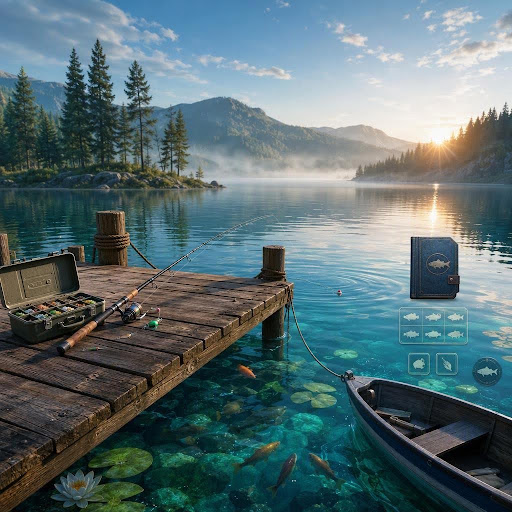
There’s something wonderfully familiar about a fishing game. You cast a line, wait for a nibble, reel something in, then decide whether to keep it, sell it, display it or simply admire the latest addition to your collection. It’s a loop most of us understand straight away, even if we’ve never held a rod in real life.
That clarity matters when you’re browsing for something new to play. Amid huge maps, complicated menus and games asking for dozens of hours, fishing themes offer an easy invitation. Water, tackle, colourful catches and a clear next step, it all reads at a glance.
From quiet simulation games to bright arcade diversions, fishing remains one of gaming’s most reliable comfort genres. The theme can be peaceful, playful or a little bit silly, but its basic appeal stays remarkably consistent.
Game discovery can feel oddly tiring. You might fancy playing something, yet spend longer scrolling through libraries and store pages than actually picking a title. Familiar themes help cut through that uncertainty, and fishing is one of the clearest examples.
You generally know the shape of the experience before starting:
That’s not to say every fishing game is identical. Some focus on patient timing, some turn catching into a fast reflex test, and others weave it into a larger adventure. Still, the underlying language is easy to read. A pond suggests possibility. A tackle box implies preparation. A bigger fish silhouette hints at a longer-term goal.
It’s a brilliant bit of visual shorthand. You don’t need a lengthy tutorial to grasp why you’re there.
Fishing also travels well between genres. It can be the central activity in a simulation, a welcome side pursuit in an adventure, or the basis for a compact arcade experience. That flexibility means players can seek out the mood they want without leaving the familiar hook-and-catch structure behind.
Comfort games aren’t necessarily games where nothing happens. Rather, they’re often games that let you understand the rhythm quickly and settle into it at your own pace. Fishing is built for exactly that.
A good fishing loop usually gives you an immediate objective. Catch a certain species. Fill a page in a journal. Reach a new stretch of water. Improve a piece of gear. These aims are concrete and easy to remember.
Compare that with a game that asks you to learn a sprawling crafting tree, several combat systems and a dense fictional history before it gets going. There’s room for those games, of course, but sometimes you just want a goal you can explain in one sentence.
Fishing themes tend to provide that. You see the next target, understand why it matters, and have a fair idea of what to try.
The collection element is another big reason fishing games stick around. Whether it’s a museum display, a notebook, a bestiary or a simple list of fish silhouettes, there’s satisfaction in seeing blank spaces gradually fill up.
It’s a gentle form of progress. You might catch something common at first, then spot a new shape in a different location or weather condition. Suddenly, a familiar lake feels fresh again.
Many of us enjoy that small sense of order. A collection gives the session a purpose without making it feel like homework. You can set yourself a tiny aim, such as finding one unfamiliar species, and call it a day once you’ve done it.
Repetition is everywhere in games, but it only feels good when the action itself is readable and the result has meaning. Fishing manages this neatly. The repeated act of casting becomes a routine, while variations in timing, location, bait, fish behaviour or presentation keep the routine from becoming completely flat.
There’s also a lovely rhythm to the pause between actions. You make a choice, wait for feedback, then respond. In a medium that often asks for constant movement, that measured pace can feel like a relief.
Fishing themes have a visual advantage before a single mechanic is explained. Water is naturally expressive. It can be glassy and calm, choppy and stormy, deep blue, bright turquoise or almost black beneath a night sky.
For arcade-style games, the theme becomes even more readable. Fish can be large, colourful and instantly distinct from one another. Hooks, nets, boats, bubbles and treasure-like objects are all easy to spot. You know where your attention should go.
Arcade games rely on immediate recognition. A player should be able to glance at the screen and understand the important shapes, especially during a short session.
Fishing imagery helps because it is naturally graphic:
It’s the same reason a classic arcade cabinet can communicate so much through a handful of symbols. The art does part of the teaching.
Sound matters too. Water lapping against a shore, a line landing on the surface, a gentle reel clicking into motion, these noises establish a setting quickly. Even a lively fishing game can use familiar aquatic audio cues to keep its world coherent.
I find that this is part of why fishing settings are so easy to return to. They feel like places, rather than merely stages. A harbour, riverbank or reef can have its own personality, and you don’t need pages of dialogue to understand it.
Not every gaming session needs to become an evening-long commitment. Sometimes you’ve finished a demanding quest, taken a break from a competitive match, or simply have a short window of time. A fishing-themed game can fit nicely into that space.
The mechanics are often approachable because they favour a small set of actions: aim, cast, wait, react and collect. Once you know the basics, you can step away and come back later without feeling lost.
That makes fishing games useful as a palate cleanser between larger experiences. They offer a change of pace, a different colour palette and a clearer immediate task. You can play for a brief period and still feel as though you’ve completed something, whether that’s landing one new species or improving a personal collection.
Short-session design doesn’t mean shallow design, either. The best examples leave room for curiosity. Perhaps a new area becomes available, a rare silhouette appears in your catalogue, or a different tool slightly changes the feel of play. The game gives you a reason to return, but it doesn’t demand that you memorise an encyclopaedia before you can enjoy yourself.
If fishing is the bit of a larger game you always end up returning to, it’s worth looking beyond games marketed solely as fishing simulators. Collecting games, light management games and arcade-style experiences often share the same enjoyable structure: simple actions, visible progress and an inviting setting.
A few good routes to explore include:
For broader recommendations and current coverage, browse The Game Haus gaming section. It’s a useful starting point when you’re looking for a new genre to try, whether you fancy something cosy, competitive or simply easy to pick up for a short while.
The common thread is not necessarily the rod and reel. It’s the pleasure of a legible loop. You know what you’re trying to do, you can see your progress, and each session has room for a small surprise.
This section is for UK adults aged 18+ only. Fishing themes also appear in adult gambling entertainment, which is separate from mainstream gaming culture and should always be approached responsibly.
UK adults (18+) who choose to explore an adult-oriented fishing-themed slot can find Virgin Games and its Fishin’ Frenzy title. The presentation uses familiar fishing imagery, including sea-life iconography and an accessible arcade-style visual format, which helps explain why the theme remains recognisable across very different forms of entertainment.
If gambling stops being enjoyable, take a break. Support and practical information are available through GambleAware.
Fishing’s staying power in games comes down to a simple truth: it makes sense quickly. The setting is welcoming, the goals are easy to read, and the next small objective is usually right there in front of you. Sometimes that’s exactly what you want from a game.


Players must be 21 years of age or older or reach the minimum age for gambling in their respective state and located in jurisdictions where online gambling is legal. Please play responsibly. Bet with your head, not over it. If you or someone you know has a gambling problem, and wants help, call or visit: (a) the Council on Compulsive Gambling of New Jersey at 1-800-Gambler or www.800gambler.org; or (b) Gamblers Anonymous at 855-2-CALL-GA or www.gamblersanonymous.org.