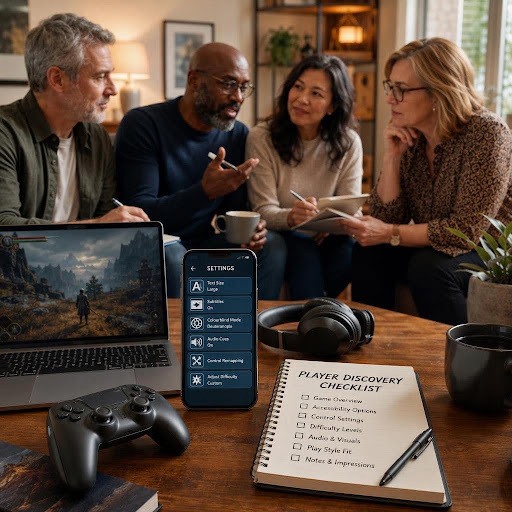
A new game arrives, the trailers look polished, social feeds fill with clips and suddenly it feels as though everyone’s talking about it. That’s often the point where it’s worth pausing.
Launch week can be great fun, but discovering something new shouldn’t mean simply following the loudest conversation. A game that suits your mate, a favourite streamer or the reviews roundup might not suit the way you like to spend your time. The useful question isn’t “Is this the biggest release?” It’s “Is there enough here that I’ll enjoy coming back to it?”
This checklist is about looking beyond the noise. Whether you’re considering a console release, a mobile title or another form of adult entertainment, a few sensible checks can make the decision feel much clearer.
There’s nothing wrong with being interested in a new release. Part of the pleasure is seeing fresh ideas, new worlds and unfamiliar mechanics appear for the first time. Still, launch coverage tends to reward what is immediate: striking visuals, dramatic moments and bold claims.
The things that matter after an hour or two are often quieter:
I find it helps to separate curiosity from commitment. You can be curious about a launch without deciding it deserves your time straight away. Watch a little footage, read a range of opinions and give yourself permission to wait for the details that matter to emerge.
Early patches, clearer guides and more grounded player discussion often arrive shortly after release. Being patient isn’t missing out. It’s choosing with better information.
“New” can mean several different things. Sometimes it’s a genuinely fresh mechanic. Sometimes it’s a familiar format with a new setting, a distinct art direction or a better-designed interface. Neither is automatically better, but knowing which one you’re looking at helps set fair expectations.
A trailer may show the biggest set pieces, but a game’s real character lies in its repeated actions. Are you solving puzzles, making tactical decisions, exploring, collecting, responding to timed prompts or managing resources?
Try to find out what the typical five minutes looks like. A launch can have a brilliant opening and still not fit your tastes if its core loop becomes repetitive for you.
Look for details such as:
A game doesn’t need to be complicated to be interesting. It does need to be honest about what it is.
Theme isn’t just a coat of paint. It shapes the mood, the type of humour, the visual language and how inviting a game feels from the outset. You might love a carefully observed historical setting but have no interest in fantasy combat, or prefer something colourful and light-hearted over a grim survival story.
Presentation also includes the practical stuff. Is the text readable? Can subtitles be switched on? Does the soundtrack support the experience without drowning out useful cues? Are menus laid out in a way that makes sense?
First impressions can be misleading, but they’re not meaningless. If a game looks confusing before you’ve even begun, that can be a fair warning sign.
Marketing descriptions are designed to create interest, not explain every limitation. Look beyond phrases such as “ground-breaking” or “limitless” and seek concrete information.
Useful first-impression signals include:
If the details are difficult to find, that’s information in itself.
Reviews are helpful, but no review is a verdict handed down from on high. One writer may care deeply about narrative while another focuses on technical performance. A player who enjoys long sessions might see a very different game from someone who has only a short window in the evening.
The answer is to build a small, balanced picture.
A numerical score can be handy, yet the body of a review is where the value sits. Look for reviewers who explain why a feature worked or didn’t work for them.
Pay particular attention to comments on:
Two reviews can disagree completely and both be useful. Their disagreement might reveal that the game depends heavily on personal preference.
Forums, comment sections and community spaces can flag practical issues that formal reviews haven’t covered. Perhaps a particular device struggles with the game, perhaps an update has changed something important, or perhaps a guide explains an unclear rule far better than the official material.
That said, take launch-week comments with a pinch of salt. Strong opinions travel fast, whether glowing or gloomy. Search for patterns rather than treating one post as proof.
Questions worth asking include:
Watching unedited or lightly edited footage can be more revealing than a trailer. You’ll see how long routine actions take, how the interface behaves and whether the presenter needs repeated explanations to understand the basics.
Don’t copy a creator’s opinion wholesale. Instead, watch their hands-on experience and imagine yourself playing. Would that pace work for you? Would those visual effects or repeated actions become tiring?
Rule clarity matters here too. A game should not make you hunt for the fundamental information needed to take part. Clear rules make an experience easier to assess and, often, more enjoyable.
A game can have excellent ideas and still be frustrating if it’s awkward to use. Accessibility, mobile design and onboarding aren’t minor extras. They can make the difference between a smooth first session and closing the app or putting down the controller.
Accessibility can mean different things for different players, but clear customisation benefits almost everyone. Text size, subtitle options, remappable controls, colour settings, audio adjustments and reduced-motion choices are all worth checking where relevant.
The broader principle comes from usability: a product should help people carry out its intended tasks without unnecessary confusion. Usability testing is built around observing how people actually use a product, rather than assuming that a polished-looking design is automatically intuitive.
For players, the simple test is: can you change what you need to change, and can you find those settings without a scavenger hunt?
If a release is intended for mobile, check how it works in the format you’ll actually use. Small screens are unforgiving. Buttons need space, text needs to remain legible and important information shouldn’t disappear beneath pop-ups or crowded menus.
Before committing your time, consider:
A quick look at real mobile footage can answer many of these points.
Onboarding should give you enough confidence to begin, then let you get on with it. The best tutorials explain the essentials when they matter, offer a place to revisit the rules and avoid burying you in instructions before you’ve done anything.
Transparent information is equally important. You should be able to see what a game involves, what features are optional and what the relevant rules are before making a decision.
Online slots are not the same as ordinary game releases, and they should be considered separately. They are gambling products for adults, not a substitute for a hobby, a way to make money or a test of gaming skill.
If you are 18 or over and choosing to look at this category, treat research as a basic part of the decision. For example, Virgin Games’ new online slots catalogue can be used as a discovery reference to review available themes, game rules and operator-supplied information before deciding whether the category is suitable for you.
Keep the scope narrow and practical. Read the game information, understand how a title works, and check the operator’s terms and safer-gambling information. Don’t treat promotional language or a theme you happen to like as a reason to take part.
Only use operators that are authorised to serve customers in Great Britain. The Gambling Commission’s public register is available for checking licence information.
A sensible discovery process includes knowing when not to proceed. If something is unclear, makes you uncomfortable or asks for more time than you want to give it, you can leave it there.
For any adult who chooses to gamble, set boundaries before starting. Decide on a limit you’re comfortable losing, set a time limit and don’t change either decision in the moment. Licensed operators provide tools such as deposit limits, time-outs and self-exclusion options. You can also find independent information and support through GamCare and use GAMSTOP if you want to exclude yourself from participating online gambling businesses in Great Britain.
New launches will always bring plenty of noise. The useful skill is learning what to listen for. Look for clear rules, practical evidence, accessible design and a genuine match with your interests. That approach may not be as dramatic as jumping in on day one, but it gives you a far better chance of finding something you’ll actually enjoy.


Players must be 21 years of age or older or reach the minimum age for gambling in their respective state and located in jurisdictions where online gambling is legal. Please play responsibly. Bet with your head, not over it. If you or someone you know has a gambling problem, and wants help, call or visit: (a) the Council on Compulsive Gambling of New Jersey at 1-800-Gambler or www.800gambler.org; or (b) Gamblers Anonymous at 855-2-CALL-GA or www.gamblersanonymous.org.