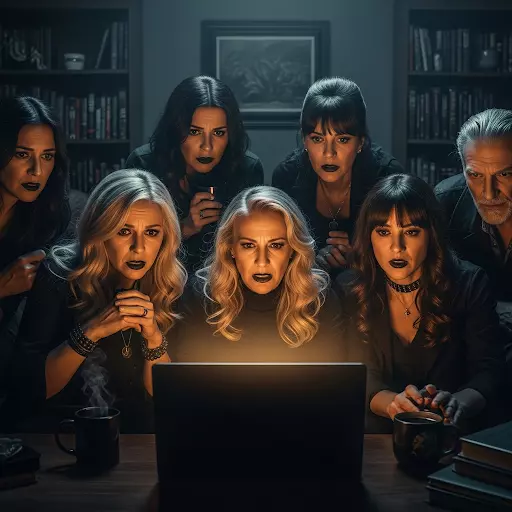
There is a very specific kind of quiet that happens just before something big is revealed. You’ve likely felt it while sitting in a darkened cinema, clutching a tub of popcorn, waiting for the protagonist to open that one creaky door they definitely should have left alone. It’s that breathless moment where your sense of anticipation grows, not because of what’s happening, but because of what might happen. I’ve always found it fascinating how that exact same feeling crops up in the most unexpected places, particularly when we’re gathered together for a bit of social gaming.
On the surface, a group of people playing a draw-based game might seem worlds away from a midnight screening of a classic slasher. One is bright, loud, and full of chatter; the other is dim and focused on the macabre. Yet, when you look at the underlying mechanics of how we experience suspense, the two are practically siblings. It is all about the ritual of the wait. Whether it’s the slow crawl of a masked figure across a lawn or the steady calling of numbers in a digital room, the human brain reacts to the build-up in much the same way.
Psychologically speaking, we are hardwired to find the unknown both slightly terrifying and deeply engaging. This is what horror directors bank on. They know that the monster you don’t see is always scarier than the one you do. Social gaming operates on a similar frequency of uncertainty. When you’re participating in a live draw, there’s a shared state of limbo. Everyone is waiting for the same outcome, but nobody knows what it will be.
This shared uncertainty creates a powerful psychological bond. I find that when we’re in a state of high anticipation, our focus narrows. The outside world drops away; the laundry that needs doing or the emails waiting in the inbox don’t matter for a few minutes. We’re purely in the moment. It is a form of mindfulness, albeit a slightly more high-tension version than what you’d find in a yoga studio. This overlap between horror suspense and interactive play isn’t accidental. It’s about the release of tension. In a film, that release comes with a jump scare or a plot twist. In a social game, it comes when the final number is called.
If you’ve ever been part of a horror fandom, you’ll know it’s one of the most welcoming and tightly-knit communities out there. There is something about sharing a frightening experience that brings people together. We see this in “watch parties” on Discord or the way horror conventions feel like big family reunions for the strange and unusual. This collective energy has started to transition quite naturally into digital gaming spaces.
Alternative lifestyle communities, particularly those who identify with the “Dark Aesthetic” or goth subcultures, have always looked for ways to socialise that don’t involve the typical loud, crowded nightclub scene. Digital hubs offer a sort of “virtual parlor” where you can be yourself while engaging in a bit of light-hearted competition. It’s quite common now to see players in these spaces chatting about their favourite obscure 80s horror flicks while they wait for the next round to begin. The game becomes the campfire around which we tell our modern stories. It provides the structure, but the community provides the soul.
We live in an age of instant gratification, but horror fans often prefer the “slow burn.” Think of films like The Witch or Hereditary, where the dread builds so slowly you almost don’t notice it until you’re completely enveloped. This pacing is a lost art in many forms of entertainment, but it’s alive and well in draw-based social games.
Unlike a fast-paced action game where everything happens in a fraction of a second, these games have a rhythmic, steady pace. Each number called is like a beat in a drum, ratcheting up the tension just a little more. You start with a full grid of possibilities, and as the game progresses, those possibilities narrow down. It’s a countdown. This mirrors the structure of a classic slasher movie where the “final girl” or “final boy” is slowly isolated. The anticipation isn’t just a byproduct of the game; it’s the main event. If the result was instant, the fun would vanish. We want the wait. We want the lingering feeling of “what if?”
In the UK, we’ve seen a massive shift in how people spend their downtime. The traditional image of a gaming hall—smoke-filled rooms and uncomfortable plastic chairs—is firmly a thing of the past. Instead, we’ve entered an era of the “digital parlour.” This revolution has been particularly embraced by modern, alternative audiences who want a bit of edge with their entertainment.
As traditional gaming formats are rebranded for a more tech-savvy and aesthetically conscious generation, we’re seeing a rise in themed social hubs. These aren’t just places to play; they’re places to belong. Many people have turned to bingo sites uk as a way to find that specific blend of community-driven tension and social interaction. It’s about more than just the numbers on the screen; it’s about the banter in the chat logs and the shared collective breath as the final ball rolls out. For the “Dark Aesthetic” crowd, these platforms offer a way to engage in a classic British pastime without it feeling dated or stuffy. It’s gaming with a bit of character.
The reason these sites have stayed so popular in the UK is their ability to adapt. They’ve realised that humans are social creatures who crave a bit of drama. By leaning into the “theatre” of the draw, they provide an experience that feels much more like an evening at the theatre or a night watching a suspenseful thriller than a simple computer programme.
When you’re looking for this kind of high-tension, community-focused experience, the platform matters. Not all digital spaces are created equal. Some feel cold and mechanical, while others manage to capture that elusive “vibe” that keeps people coming back.
Platforms like Jackpotjoy have become leaders in this regard by focusing heavily on the social element. They understand that for many of us, the game is just the backdrop for the conversation. By creating an environment where the chat is as important as the draw, they’ve managed to attract a demographic that values connection and atmosphere. For those who enjoy the darker side of fiction, this sense of “controlled tension” is perfect. You get the suspense, the communal reaction, and the eventual resolution, all from the comfort of your own sofa, perhaps with a black coffee and a horror novel nearby.
It is interesting to see how these spaces have evolved to cater to such a wide variety of tastes. You’ll find people from all walks of life there, but there’s a shared understanding of the “ritual.” We all know the rules of the game, just as we all know the rules of a horror movie (don’t go into the basement, don’t say “I’ll be right back”). Following these rituals together is what makes the experience feel authentic.
At the end of the day, whether we’re watching a masked killer stalk through the woods or watching a digital tumbler spin, we’re looking for the same thing: a moment of genuine connection and a bit of a break from the mundane. The “ritual of the draw” is a centuries-old concept that has simply found a new home in our digital world.
It reminds us that even when we’re sitting alone in front of a screen, we’re not actually alone. We’re part of a crowd, all experiencing the same “slow burn” of anticipation. We’re all waiting for that door to open, for that final number to drop, or for the credits to roll. And as long as we have that shared sense of suspense, these social spaces will continue to thrive, providing a little bit of mystery and a lot of community for those of us who like things a little more atmospheric.
It’s quite a comfort, really, to know that in a world that often feels disconnected, we can still find a place where the simple act of waiting together becomes a pleasant part of an evening. Whether you’re there for the win or just for the sharing funny stories in the chat, the ritual remains the same. It’s the suspense that keeps us human.
***
Please gamble responsibly. For more information and support, visit BeGambleAware.org or call the National Gambling Helpline on 0808 8020 133. You must be 18 or over to participate in any form of gambling in the UK.


Players must be 21 years of age or older or reach the minimum age for gambling in their respective state and located in jurisdictions where online gambling is legal. Please play responsibly. Bet with your head, not over it. If you or someone you know has a gambling problem, and wants help, call or visit: (a) the Council on Compulsive Gambling of New Jersey at 1-800-Gambler or www.800gambler.org; or (b) Gamblers Anonymous at 855-2-CALL-GA or www.gamblersanonymous.org.