A best-of-three in Counter-Strike 2 gets settled twice. The second time is on the server. The first is in the veto, a couple of minutes of banning and picking that finishes before either roster loads in.
By the time the third map is locked, both sides already know which of them is playing on friendlier ground. So does the price.
Valve keeps one competitive group of maps and tournaments play out of it. The group is called Active Duty, and Valve’s own Major rulebook sends organizers to whatever is sitting in it at the time.
Its size is fixed by the veto rather than by taste. A best-of-three removes four maps and has each team pick one. The seventh map is left standing as the decider, and a best-of-one runs the same group down by six.
Maps join and leave that group between events, so a team’s map pool depth is a moving target. A roster can spend a season building a map and then find it gone, with the practice behind it worth nothing on the ban screen.
Seeding decides who bans first, and at a Major the seeds come out of Valve’s own ranking system. The higher seed chooses which chair to sit in. Everything after that is fixed.
One team removes a map, the other removes a map, and then each picks the map it wants to play. Two further bans follow. The map nobody managed to remove becomes the decider.
So each side plays one map it chose, one map the opponent chose, and a third that neither could get rid of. The map a side did not choose is the one that quietly settles series, because the opponent selected it to be uncomfortable.
Prices move on a veto because the veto strips out most of the uncertainty about where a series will actually be played. Two rosters can look level on paper and sit a long way apart once the third map is known.
That is a reason to read a board again after the maps are locked. A single series carries match winner, map winner and handicap markets at the same time, so one veto result reprices all three. Both sides of each of those prices come from traders rather than from a house, and the CS2 matches open on OVERDOG are listed that way.
None of this needs an opinion about the rosters. The veto is a public sequence with a public result, and the arithmetic that turns it into a series number works the same for both sides.
Give a team a win chance on each of the three maps and the series answers itself. It takes the series by winning two of them, and the decider is only played once the score reaches one map each.
Treat that decider as a coin flip and the sum collapses into something a bettor can do in their head. The series chance becomes the average of the two picked maps, which means a point gained on the opponent’s pick is worth half a point on the series.
Take a side that wins 70% of the time on the map it picks itself. Against an opponent whose pick it still takes 44% of the time, that is a 57% series. Drop the same team to 24% on the opponent’s pick and the series reads 47%.
The gap is ten points.
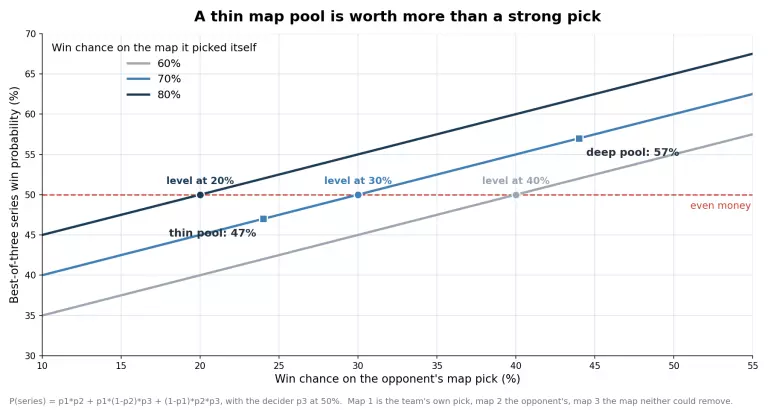
None of those ten points came from the map the team is good at. The balance points make the argument more bluntly. A side winning 80% on its own pick is no better than a coin flip once it falls to 20% on the opponent’s, and a 60% pick balances at 40%.
That is why map pool depth beats a strong pick. One map a team cannot play is worth more to the opponent than one map it plays brilliantly.
Reading a veto well is not something the professionals have solved either. Across thousands of real picks and bans, teams leave wins on the table in the veto itself, on the picking side and the banning side alike.
Habit covers most of it. A map gets banned because it was banned last month, or picked because it is the map the coach trusts, and the sample underneath either decision can be thin.
Roster moves make that record staler still. One incoming player changes who anchors a site and who calls the mid-round. So a single transfer window can leave a map record describing a team that no longer exists.
There is a practical problem with getting good at this. A venue that holds the other half of every bet has a reason to notice. The accounts winning more than the average bettor are the ones more likely to end up restricted.
Nothing about that requires the bettor to have done anything wrong. The house owns the opposite half of the slip, which makes a consistently correct customer a running cost, and trimming the stake is the cheapest way to stop paying it.
Where another trader holds that opposite half instead, the calculation never arises. OVERDOG’s own cut is a flat 1% whether the bet is one map or the whole series, with Polymarket’s own fee charged on top. Neither number changes for a bettor who ends a season in front. What caps a large stake on that route is the money already resting at the price, rather than a ruling on who deserves to keep betting.
The veto is the cheapest homework in Counter-Strike. It is public, it is short, and it runs in an order that does not change from one event to the next.
What it takes is a current map record for both sides and a willingness to weight the weak end of it hardest. A lopsided pool shows up most plainly in map winner and handicap markets, since each of those asks about one map rather than the whole series.
A series is decided by which maps survived at least as often as by which roster is better. Any live price already carries some of that. Whether it carries it as well as the map record does is the open question on a given match.


Players must be 21 years of age or older or reach the minimum age for gambling in their respective state and located in jurisdictions where online gambling is legal. Please play responsibly. Bet with your head, not over it. If you or someone you know has a gambling problem, and wants help, call or visit: (a) the Council on Compulsive Gambling of New Jersey at 1-800-Gambler or www.800gambler.org; or (b) Gamblers Anonymous at 855-2-CALL-GA or www.gamblersanonymous.org.