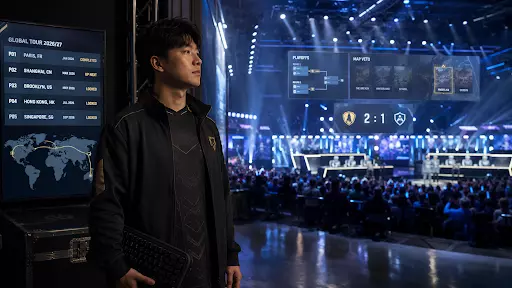
Late 2026 is less a tournament season than a relay race between cities, publishers, and competitive ecosystems. As of August 11, the Esport World Cup is entering its sixth week in Paris, The International begins its Shanghai arena stage on August 20, VALORANT Champions arrives there in September, and League of Legends Worlds finishes at Barclays Center in Brooklyn on November 14. Counter-Strike then takes over November and December with BLAST Rivals in Hong Kong and the PGL Major in Singapore. The map has changed.
The 2026 Esport World Cup was originally planned for Riyadh before the Esports World Cup Foundation announced in May that the event would instead be staged in Paris. The July 6–August 23 schedule remained intact, along with 25 tournaments across 24 games and a prize pool exceeding $75 million; more than 2,000 players and 200 clubs were expected. By Week 6, Rocket League alone brings 16 teams to Paris Expo Porte de Versailles from August 12–16 for a $1 million competition. Moving an event of that scale between continents without shrinking the program has become one of the year’s biggest global esport stories.
Dota 2 and VALORANT will ask Shanghai crowds to switch competitive languages within weeks. The International’s arena phase runs August 20–23 at the SPD Bank Oriental Sports Center, while VALORANT Champions Shanghai runs from September 24 to October 18 with 16 teams. Dota 2 can hinge on economy, map control, and a fight prepared several minutes earlier; VALORANT compresses pressure into utility timing, site entries, and the economy of individual rounds. Among 2026 esports tournaments, few pairings show more clearly how different top esports titles can be while still attracting the same international audience.
League of Legends Worlds runs from October 15 to November 14, bringing together 19 teams across three stops in the United States. It starts in Los Angeles, heads to Allen, Texas for the Swiss stage and knockout rounds, and wraps up in Brooklyn with the Grand Final at Barclays Center. Over the course of a month, things rarely stay static. Draft priorities shift, side selection starts to matter more, and teams slowly reveal how well they’re actually reading the patch. A squad that looks polished in California can arrive in New York with a completely different identity. Because of that, any real ranking of the top contenders has to stay fluid and adjust as the tournament develops, not just reflect what happened in the summer.
Esports prices respond quickly to roster confirmations, map pools, format changes, and tournament form, but the shortest number is still only a market price. A useful esport odds comparison should check identical markets and settlement rules across esport betting sites before treating any difference as meaningful. The same approach used in football betting (Arabic: مراهنات كرة القدم) also applies to esports: treat the odds as just a price, not the story, and decide your stake before emotions or a surprise result affect the next call. In games like Counter-Strike or VALORANT, a map veto or confirmed lineup often says more about how the match will play out than a sudden shift in the odds.
November is bringing something a bit unusual, with no real equivalent on the regular club calendar. The first Esports Nations Cup is set for Riyadh, a multi-title event built around national teams instead of organizations, intentionally separated from the club-based structure used at EWC. Esports games have usually centered loyalty on teams, players, and publisher ecosystems, so national identity will need to find its place rather than simply carry over from traditional sport. If it works, late 2026 could end up adding a second competitive layer without replacing the clubs.
Counter-Strike ends the year with almost no breathing room. BLAST Rivals S2 takes place in Hong Kong from November 11–15, featuring eight invited teams. BLAST is putting up a total of $1 million in team compensation, with $350,000 allocated to prize money and $650,000 distributed as team payments.
Just ten days later, the PGL CS2 Major Singapore kicks off on November 25 and runs until December 13. It will feature 32 teams, three stages of competition, and a best-of-five Grand Final at the Singapore Indoor Stadium. By the time these events roll around, things like map pool depth, CT-side tweaks, and careful veto prep will matter far more than any reputation built earlier in the year.


Players must be 21 years of age or older or reach the minimum age for gambling in their respective state and located in jurisdictions where online gambling is legal. Please play responsibly. Bet with your head, not over it. If you or someone you know has a gambling problem, and wants help, call or visit: (a) the Council on Compulsive Gambling of New Jersey at 1-800-Gambler or www.800gambler.org; or (b) Gamblers Anonymous at 855-2-CALL-GA or www.gamblersanonymous.org.