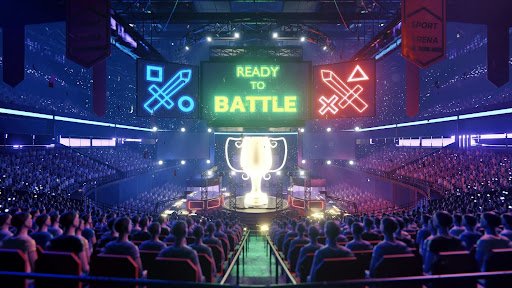
Esports, or electronic sports, began as crews of gamers in cybercafes and has grown into full stadiums, multi-million-dollar tournaments, and sponsorship deals from some of the world’s biggest businesses. Tens of millions of viewers watch worldwide as players compete on the highest levels. With that kind of rapid growth has come an inevitable question: Is esports a sport?
The discussion of esports tends to overlap with markets that have the same competitive entertainment-seeking audience. One such industry is betting, which happens to be a significant aspect of both mainstream sports and esports. Online websites allow fans easy access, with some allowing a minimum deposit of $10 to start. This access is representative of the degree to which esports mimics the structure of traditional sports, both in competition and in the surrounding industries that function around them.
It’s not an easy question to answer, because the term “sport” is not as clear-cut as most would think. In order to fully understand the argument, we need to look at how sports have generally been defined, what makes esports different, and why people are so divided about it.
Most people think of sports as physical contests, like football, basketball, or tennis. Oxford English Dictionary defines a sport as “an activity involving physical exertion and skill in which an individual or team competes against another or others for entertainment.” Taking the definition at face value, the “physical exertion” part seems to rule out video games.
But history demonstrates that sport has never been defined merely as running more quickly or lifting more. Snooker and even chess are all accepted as sports, despite needing relatively minimal physical movement. If chess is a sport, then surely esports is too. Esports isn’t the only one fighting for acknowledgement as a sport, either. Darts has been fighting a battle to be accepted as a sport, as well as the popular card game, bridge.
While there have already been some steps taken to start recognising esports as an official sport, it still has a long way to go before it might be officially recognized. Here is what esports currently has in its favor.
The best professional gamers practice for hundreds of hours, often between six and ten hours a day. They practice reaction time, teamwork strategy, and prolonged concentration. Research on esports has shown that professional gamers perform hundreds of moves per minute with remarkable hand-eye coordination and intellect. When playing, their heart rates and pressure levels rise just like in the case of athletes in traditional sports.
Esports is not a pickup game free-for-all. It has governing boards, leagues, and tournaments, and rules and regulations governed by them. Organization is provided by the International Esports Federation and national associations, while there are coaches, analysts, and nutritionists to take care of individual players on behalf of teams. In virtually every way, the arrangements are very similar to the arrangements that encircle professional football or basketball.
Esports is increasingly being watched on some of the world’s biggest stages. It was formally established as an Asian Games medal event in 2022, and the International Olympic Committee has even recognized esports as a sporting activity, though it is reluctant to decide on which of the games can be deemed acceptable within Olympic values. Such recognition means that esports is not just entertainment anymore. It is heading towards being fully accepted as a sport all over the world.
Esports brings in billions of dollars every year, with viewership rising year by year. Top events like the League of Legends World Championship have more viewers than many of the world’s largest sporting events. Culturally and economically, esports is already competing head-to-head against traditional sports.
Although there are plenty of reasons to consider esports a real sport, there is a lot of opposition out there, pushing for it to be kept separate from the traditional sporting world.
The strongest criticism is simple: players are sitting in seats, not running, jumping, or lifting. To critics, this absence of athleticism is a nonstarter. They argue that sport must be athletically taxing, and esports doesn’t deliver.
Cultural conventions also enter the picture. People who grew up thinking of sport in terms of grass, sweat, and stadiums struggle to put competitive gaming on the same level. This is something that can be overcome over time, especially as the next generation is exposed to esports as part of everyday life.
Since esports is still in its developmental stage, it experiences growing pains. Match-fixing, doping, and unbalanced contracts have hit the headlines. The legacy sports have decades of governing frameworks in place, while esports is catching up. Until stricter and more normalized regulations are introduced, some think that esports is not yet ready to be called a sport.
Sports science is now also focusing more on esports. An investigation of top performers in the gaming world shows that their reflexes and multitasking capabilities typically outdo those of regular folks. Their training programs are more like mental marathons where attention and precision are pushed to the limit.
While this is happening, athletes are faced with unique physical requirements. Hours of ceaseless repetition can lead to carpal tunnel syndrome, back problems, and eye strain. Teams are now hiring physical trainers and health professionals to keep players in top shape, much as football or basketball teams. The more wellness programs the industry puts into it, the more it acts like the support systems of established sports.
Generational differences play a significant role in the controversy surrounding esports. Young viewers, having played games and watched streams since they were kids, already see esports as a natural part of sport. Later generations take longer to embrace the concept.
Other countries have welcomed esports with open arms. South Korean pro gamers are celebrated like stars, sponsored by companies and earning devoted fan bases. In the United States and Europe, colleges now award scholarships to compete in esports, officially sanctioning competitive gaming alongside basketball or soccer. These cultural shifts mean acceptance is gaining ground.
Esports has a bright future. They are building dedicated stadiums, forming broadcast alliances, and educating the next generation of players and industry professionals in colleges. To become a fully established sport, though, esports will require stronger international control, greater player welfare systems, and safer gambling frameworks.
If all those barriers are met, the difference between esports and traditional sports will be increasingly harder to discern.
So is esports a sport? It is all about how closely you interpret tradition. If you believe physical exertion is the only requirement, then esports will always fall short. But if sport is an amalgamation of skill, contest, training, and viewer involvement, then esports easily fits the bill.
Professional players spend years mastering their craft, compete in front of international audiences, and inspire the same level of fervour as established athletes. The debate can continue to war, but esports has already proven itself to be more than a form of entertainment. Whether or not individuals wish to define it as a sport, esports has earned its place among the global sporting debate.


Players must be 21 years of age or older or reach the minimum age for gambling in their respective state and located in jurisdictions where online gambling is legal. Please play responsibly. Bet with your head, not over it. If you or someone you know has a gambling problem, and wants help, call or visit: (a) the Council on Compulsive Gambling of New Jersey at 1-800-Gambler or www.800gambler.org; or (b) Gamblers Anonymous at 855-2-CALL-GA or www.gamblersanonymous.org.