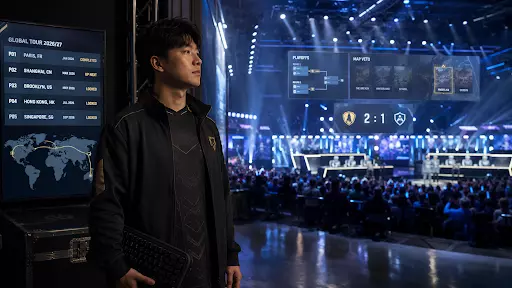
Remember when competitive gaming just meant your mates in the living room, or maybe a trip to the local gaming centre? That’s ancient history now. We’re talking full tournaments, pro teams, dedicated leagues, packed-out live events, and online audiences in the millions. That’s the shift that turned esports into a real force in gaming — and it’s still rewriting how competitive games get built, played, and watched.
Faster internet. Cheaper hardware. Digital distribution that just works. That’s the trio that made this whole thing possible. Someone in Seoul can now go head-to-head with someone in São Paulo without either of them leaving the house.
The games got sharper too. Shooters, MOBAs, strategy titles, sports sims — genres built on communication, planning, precision, and split-second reflexes. That’s exactly what makes for good organised competition, and exactly why audiences follow it the same way they’d follow a football match.
Streaming blew the doors open even wider. No TV deal needed, no ticket required — just log on and watch the pros do their thing, live, whenever. That’s built a much more direct connection between competitors and the people cheering them on.
Going pro cracked open a whole job market that simply didn’t exist before. Players compete as part of real teams now, and around them sits an entire ecosystem — coaches, analysts, commentators, event organisers, content creators, the works.
Teams run a lot like traditional sports clubs at this point. Defined roles. Training schedules. Performance targets. Coaches and analysts pick apart old matches looking for weaknesses, then build a game plan for whoever’s next on the schedule.
And it’s changed how people talk about gaming as a skill, full stop. At the top level, knowing the game isn’t enough. It takes discipline, teamwork, adaptability, and the nerve to stay sharp when everything’s on the line.
Tech is probably the single biggest thing steering where esports goes next. Faster processors, better graphics hardware, sharper monitors, stronger networks, tighter peripherals — all of it adds up to games running faster and cleaner than ever.
Latency’s the big one here. In a fast-paced game, a delay of a few milliseconds can lose you the match. Better internet infrastructure means more consistent connections, and players competing across huge distances without the lag getting in the way.
Developers are playing their part too — smarter matchmaking for fairer games, analytics tools breaking down performance and strategy down to the finest detail. All of it makes competition easier to measure, and gives teams sharper data to work with.
Esports growing up has changed how developers actually build and maintain their games. Competitive titles get hit with frequent updates just to keep things balanced — a character here, a weapon there, whatever’s tipping the scales.
Balance matters more than people think. At pro level, even a tiny edge can flip an entire match. So developers watch player feedback, match stats, tournament results — anything that flags what needs tweaking.
That sets up a constant back-and-forth between players, pros, and developers. A change made purely for competitive reasons often trickles down and reshapes the game for everyday players too — which is exactly why esports has become such a big deal in how multiplayer games get built these days.
Modern esports doesn’t just run on tournaments. It runs on community. Fans aren’t passive here — they discuss matches, follow players, make content, argue in forums, and flood social media with reactions the second a game ends.
Gaming audiences bump into other forms of digital entertainment along the way too. Platforms like Spinsino show just how far online entertainment has spread across categories, giving digital audiences even more ways to engage.
A strong community keeps a game alive between the big tournaments. It pulls new players in, and it keeps the old ones from drifting off.
For the pros themselves, community engagement matters just as much as winning. Stream regularly, show up on social — and you build a following that outlasts any single tournament result. That’s blurred the line between competitive gaming, entertainment, and online content more than ever.
It’s not all smooth sailing, though. Keeping competition healthy needs real rules, fair matchmaking, and an actual answer to cheating and misconduct — not just good intentions. Organisers also have to juggle player welfare, scheduling, and the sheer pressure that comes with playing at a professional level.
Sustainability’s a genuine headache too. A game can explode in popularity almost overnight — and lose the crowd just as fast once the next big thing drops. Organisations and developers are stuck constantly adapting, trying to hold a stable competitive structure together while player tastes shift under their feet. Platforms such as Spinzino also reflect how quickly digital entertainment can evolve, making adaptability increasingly important.
Player health deserves way more attention than it used to get, and it’s finally getting some. Marathon training sessions take a real toll, physically and mentally. Rest, exercise, sleep, sensible workload — none of that’s optional if a career’s supposed to last.
Expect more overlap — gaming, streaming, tech, live entertainment, all bleeding into each other more than they already do. Better virtual experiences, sharper broadcasting tools, more interactive platforms — all of it aimed at making competitions more engaging for audiences everywhere.
At the same time, competitive gaming keeps getting more accessible for regular players. Online tournaments and community competitions mean you don’t need to be anywhere near pro level to actually take part.
As esports keeps maturing, its reach is going to stretch well past the tournament stream. It’s already changing how people think about gaming, how developers design competitive titles, and how audiences consume digital entertainment in general.
Esports took competitive gaming and turned it into something structured, sophisticated, and genuinely global. Better tech, streaming, game design, and online communities all had a hand in getting it here. Sure, there’s still real work to do on sustainability, fairness, and player wellbeing — but the impact esports has had on gaming overall? That’s not really up for debate anymore.
And as tech and gaming habits keep changing, esports isn’t going anywhere. If anything, it is set to remain central to the future of competitive entertainment – bringing together players, developers and audiences through an ever-expanding mix of digital experiences.


Players must be 21 years of age or older or reach the minimum age for gambling in their respective state and located in jurisdictions where online gambling is legal. Please play responsibly. Bet with your head, not over it. If you or someone you know has a gambling problem, and wants help, call or visit: (a) the Council on Compulsive Gambling of New Jersey at 1-800-Gambler or www.800gambler.org; or (b) Gamblers Anonymous at 855-2-CALL-GA or www.gamblersanonymous.org.