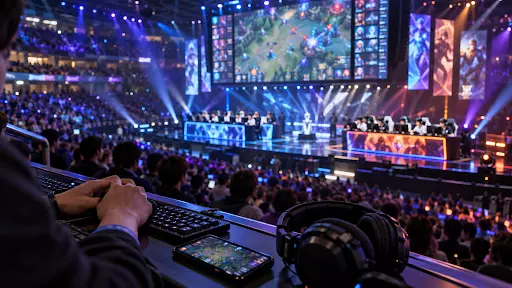
The 2026 IEM Cologne Major generated more than 100 million hours watched and peaked at over 2.75 million viewers, according to ESL FACEIT Group, making it the most-watched Counter-Strike tournament in history. Team Falcons beat FURIA 3-0 in the final, and Ilya “m0NESY” Osipov collected the ESL Pro Tour MVP award after three weeks of CS2 competition. Those numbers describe an entertainment product with professional teams, recognizable players, packed arenas, and a global broadcast audience. Esports news now sits comfortably beside traditional sports coverage because the competitive calendar no longer looks temporary.
Modern esports tournaments create narratives that run across most of the year rather than disappearing after one weekend. Counter-Strike’s Cologne Major ran from June 2-21, while Dota 2’s The International brought 16 teams to Shanghai in August and ended with Team Spirit reclaiming the Aegis. League of Legends is still building toward Worlds, scheduled from October 15 to November 14, with stages in Los Angeles and Allen, Texas, before the final at Barclays Center in Brooklyn. Fans can now follow qualification races, roster form, and championship pressure across an organized season.
NiKo did not need an introduction in Cologne. He needed the one trophy missing from his résumé. Falcons’ 3-0 win over FURIA finally gave him a Major, and that was the story people carried out of the arena. m0NESY taking the MVP award almost felt secondary, even though his form was one of the reasons Falcons got there in the first place. That is where esports has changed most as spectator culture: fans remember careers, grudges, roster moves, and disastrous deciding maps, not just who finished first in the bracket.
Esports markets can cover series winners, map winners, totals, and handicaps across CS2, League of Legends, and Dota 2, each with different competitive structures. Adults exploring online betting in zambia can compare those prices with map pools, recent series results, roster changes, and tournament format instead of treating a famous organization’s logo as sufficient evidence. A best-of-five CS2 Major final creates a different probability problem from a best-of-three group match, while a Dota patch can change which heroes and strategies become valuable almost overnight. Betting fits the ecosystem most naturally when the analysis begins with the actual competitive rules.
Esports developed alongside streaming, which allows viewers to watch and discuss the same map, draft, or team fight in real time rather than reading a result hours later. Cologne’s audience record illustrates that scale, while The International pairs official broadcasts with in-game viewing, fantasy predictions, and supporter features tied to the tournament. Co-streams, chat, clips, and social posts keep the conversation moving during pauses between maps and series. A viewer can be a spectator, an analyst, and a community participant within the same evening.
For adults who follow odds, esports can sit beside football or tennis because the competition has published schedules, teams, statistics, and live outcomes rather than an improvised format. MelBet lists esports as part of its sports product, allowing users to follow pre-match and live markets while official tournament broadcasts remain the primary source for the actual competition. Map records, current rosters, patch changes, and series length are more useful than vague assumptions about a team being “good online” or “strong on LAN.” More betting markets expand the ways a match can be analyzed, but they do not remove the variance built into professional play.
The International finished in August, IEM Cologne crowned Falcons in June, and League of Legends Worlds will run into November, so elite competitive gaming now fills most of the calendar. Fans can play the same titles, follow professional rosters, watch streams, buy team-related digital items, and argue over drafts or map vetoes without ever entering a tournament themselves. Counter-Strike has sustained that competitive identity for more than two decades, while Dota and League have built annual world championships into recurring cultural events. Esports became important to gaming because it gave games something releases alone cannot provide: an ongoing public season.


Players must be 21 years of age or older or reach the minimum age for gambling in their respective state and located in jurisdictions where online gambling is legal. Please play responsibly. Bet with your head, not over it. If you or someone you know has a gambling problem, and wants help, call or visit: (a) the Council on Compulsive Gambling of New Jersey at 1-800-Gambler or www.800gambler.org; or (b) Gamblers Anonymous at 855-2-CALL-GA or www.gamblersanonymous.org.