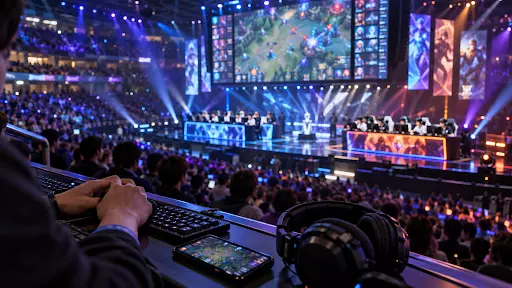
It was the pistol round of the second half in a Major quarterfinal, and the underdog’s AWPer had just won a 1v3 with a Glock. My Discord lost its mind. Out of pure curiosity I opened a betting app, and the map winner market was already locked. About twenty seconds later it came back, and the favorite’s price had drifted out by a mile. Half my friends hadn’t even finished typing “WHAT.”
So who moved that number, and how did it happen so fast? That question is how I ended up googling “how does esports betting work” at 2 a.m. instead of sleeping. The short answer is a relay of data feeds, pricing models and risk software, all passing the ball to each other every second of the match. The longer answer is more fun, so let’s walk through it piece by piece.
In traditional sports, data companies often send scouts to the stadium to tap every event into a tablet. Esports mostly skips that step. The game already knows everything: every kill, every bomb plant, every gold swing, every dragon. Tournament organizers pipe that information straight out of the game server, and licensed data companies package it into a feed that sportsbooks can read.
That’s where “official data” comes in. Data firms pay leagues and organizers for the right to distribute match data, and in return they get the fastest, cleanest version of it. Unofficial feeds exist too, usually scraped from broadcasts, but they’re slower and a lot messier.
Speed is everything here. The stream you’re watching often runs on a broadcast delay, sometimes a couple of minutes at big events, partly so teams can’t ghost each other. The server feed has no such delay. So by the time you see that clutch on screen, the bookmaker has known about it for a while. If you follow the CS2 scene closely, you’ve probably noticed markets locking a beat before anything happens on your stream. Now you know why.
Once the data lands, it goes to the odds engine. I pictured some genius trader in a dark room. Nope. It’s mostly math, and it has a really long memory. Team ratings, last month’s form, who beat who before, a roster swap last week. And in esports there’s one more thing football never worries about: the map pool, or whatever patch just dropped.
That’s the part that makes esports odds so weird. Take a CS2 squad that’s scary on Mirage but falls apart on Nuke. The veto happens, and boom, the price moves before anyone has bought a gun. League is even wilder. A patch lands, half the champions get nerfed, and some teams figure it out in a week while others look lost for a month. Imagine if a football pitch changed shape every fortnight.
Lots of engines just play the match out thousands of times in a simulation. If Team A takes 60% of those fake series, the “fair” price lands somewhere around 1.67 in decimal odds.
Spoiler: you won’t see 1.67. The book shaves a bit off first. People call it the vig, or the overround, or just the margin, and it’s why all the outcome percentages added together come to a bit more than 100%. Big Major final? Sites are fighting for your click, so that cut stays pretty small. Some random tier-three qualifier on a Wednesday? Yeah, you’re paying extra.
Pre-match odds are only half the story. A huge share of esports betting now happens while the match is running, and that’s where the tech gets really busy.
Here are some live markets you’ll usually see during a CS2 or League of Legends match:
Every time the feed reports an event, the engine reprices. A won force-buy round in CS2 nudges the odds a little. A Baron steal in LoL can swing them hard, because it often decides the game.
Then come suspensions. When something big is about to happen, like a bomb plant or a teamfight near an objective, the market locks so nobody can bet on an outcome that’s basically decided. When the dust settles, it pops back up with fresh numbers.
On top of that, a lot of books hold your live bet for a few seconds before they take it. It’s not a bug. It stops people with faster data from betting on events the book hasn’t processed yet.
Here’s the less fun bit. Esports has a match-fixing problem, and it’s worst in the lower tiers, where a player on a tiny salary might get a message offering more cash than a whole season pays. Not a great combo. The numbers back it up, too. iGaming Business reported that esports made up 54% of all suspicious betting alerts flagged by the International Betting Integrity Association in Q2 2024. That’s more than every other sport put together.
So next to the odds engine there’s usually risk software, and it doesn’t care about the game at all. It cares about the money. Say a weird pile of cash shows up on a massive underdog in some qualifier nobody’s watching. The system might slash the max bet, yank the market, or ping an integrity body. People do look at the alerts eventually. But nobody can stare at thousands of markets at once, so the software gets first look.
Now for the part I didn’t expect. The data feed, the odds engine, the risk tool, the payment wallet and the app you actually tap on are often separate products, sometimes from different suppliers. Getting all of them to agree on the same price in the same second is a serious technical job.
That’s why plenty of newer operators skip building it all themselves. Think about it: odds models for a dozen different games, data licenses, a trading team, and servers that can’t blink during a 20-hour tournament weekend. That bill gets ugly fast. So many brands in tier-1 countries just pick a white label sportsbook from a provider like Kanggiten, which hooks the feeds, pricing, player accounts and payments up into one platform. The operator worries about its brand and its community. The provider deals with the plumbing.
When this setup works, you never think about it. Odds match on your phone and laptop, markets come back fast after a pause, and winnings land right after the final round. When it doesn’t, you’ll find out within minutes of the first big play.
Knowing how the system works won’t turn you into a winning bettor. The sportsbook sees the server data before you see the stream, and every price has a margin baked in. Over a long stretch, that math wins.
But it does take the mystery out of the screen. A locked market means the feed spotted something. A sudden price drop probably means a wave of money just came in. And a weirdly generous line on a tiny qualifier might be worth a second look, just not for the reasons you’d hope.
If you’re going to bet on esports, pick a number before the series starts, and think of it like buying a ticket, not an investment. The odds engine never tilts. We do, usually right around the third overtime.


Players must be 21 years of age or older or reach the minimum age for gambling in their respective state and located in jurisdictions where online gambling is legal. Please play responsibly. Bet with your head, not over it. If you or someone you know has a gambling problem, and wants help, call or visit: (a) the Council on Compulsive Gambling of New Jersey at 1-800-Gambler or www.800gambler.org; or (b) Gamblers Anonymous at 855-2-CALL-GA or www.gamblersanonymous.org.