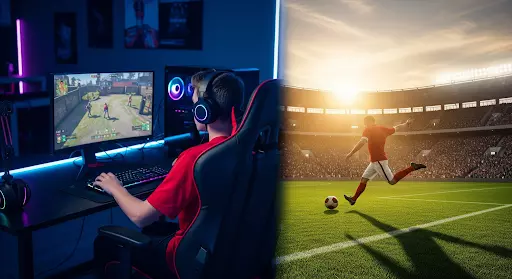
A League of Legends team and a football side do not share a pitch, but they share pressure. Both need roles, scouting, communication, emotional control, and fast adaptation when the original plan breaks. That is why African sports fans who understand football tactics can read esports faster than outsiders expect. A mid-laner caught without vision is not so different from a full-back isolated without cover. The punishment arrives quickly. The replay makes it look obvious.
Football talks about half-spaces, overloads, pressing traps, and transitions. Esports talks about vision control, cooldowns, rotations, power spikes, and objective timing. Different vocabulary. Same argument.
Teams win by controlling information before the opponent acts. In football, that may mean cutting the passing lane into midfield. In esports, it may mean denying vision near Baron or forcing a fight before an enemy composition reaches its strongest item window.
Professional esports now has coaches, analysts, scrim blocks, review sessions, roster rules, and player welfare policies. Riot’s 2026 global League of Legends regulations cover team operations, eligibility, contracts, sponsorship rules, and disciplinary procedures. That kind of structure would feel familiar to anyone who has worked inside football.
The romantic version says great players improvise. The professional version says they improvise after thousands of rehearsed situations.
Esports audiences already live in short, intense digital windows: match streams, live chats, stat pages, clips, and mobile sessions between games. A player searching for the best Plinko game Ghana is entering a casino format built on a different kind of uncertainty, where ball drops, payout multipliers, and stake choices replace drafts and team rotations. The shared point is not strategy in the football sense. It is attention management. Digital users move between long competitions and short sessions, so bankroll limits and session timing matter when the format gets faster.
Traditional sports punish late adaptation. A coach who waits too long to change shape can lose midfield control. An esports captain who ignores a lane mismatch can lose the map before the scoreboard looks bad.
The best teams react without panic. They know when to slow the game, when to trade territory, when to abandon a risky fight, and when to trust a prepared call. Adaptability sounds soft until the match clock starts burning.
Live betting has made both football and esports more analytical for fans who follow odds. On a Betpawa app, a market can shift after a red card, first blood, roster news, map veto, or tactical substitution, depending on the event. The bettor still needs to know what changed inside the contest, not just that the number moved. A football team defending a lead and an esports team scaling for late game can both look passive to a casual viewer. The disciplined read asks whether passivity is danger or design.
African esports does not need to imitate Seoul, Berlin, Los Angeles, or Shanghai to matter. It needs stable tournaments, better broadband access, local organizers, coaching literacy, and sponsors who understand that community comes before spectacle. The talent is already visible in gaming cafés, university groups, mobile competitions, Discord servers, and neighborhood rivalries.
Traditional sport offers one warning. Infrastructure decides how far talent travels. The player may have reflexes, courage, and instinct, but without structure the ceiling arrives early.
Football and esports meet at the point where instinct is not enough. The team that studies better, communicates cleaner, and adapts sooner usually survives longer. One crowd sings from concrete stands. Another types in chat at midnight. The pressure feels different, but the hands still shake before the decisive call.


Players must be 21 years of age or older or reach the minimum age for gambling in their respective state and located in jurisdictions where online gambling is legal. Please play responsibly. Bet with your head, not over it. If you or someone you know has a gambling problem, and wants help, call or visit: (a) the Council on Compulsive Gambling of New Jersey at 1-800-Gambler or www.800gambler.org; or (b) Gamblers Anonymous at 855-2-CALL-GA or www.gamblersanonymous.org.