If you have looked into college football prediction markets at all, you have almost certainly landed on Kalshi first. It accounts for roughly 69.9% of the reported $790 million traded on the sport across platforms this season.
Dominant does not mean automatic, though. State availability, fee structure and whether you want prediction markets sitting inside an account you already hold are all reasons people end up looking elsewhere.
This guide covers the alternatives worth knowing about, starting with the one we would look at first.
Three practical reasons come up repeatedly.
The first is access. Footprints differ between platforms, and the largest platform is not available everywhere, so eligibility alone rules some options in or out before anything else matters.
The second is cost structure. A flat cent-per-contract fee and a fee that scales with contract price behave very differently depending on whether you trade near the middle of the range or close to the extremes.
The third is simply where your account already lives. Several alternatives sit inside ecosystems people are already using, which removes a signup and a funding step.
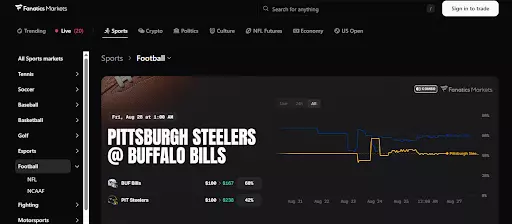
This is the alternative we would start with, and the reason is board depth backed by a published fee schedule you can check before committing.
Its college football betting section gives each game its own board with Moneyline, Spread and Total as the named market types. On the Week 4 slate, individual games carried between roughly 184 and 219 separate markets, which is genuine depth rather than a headline winner market with a total attached alongside it.
The fee position is unusually legible. The total trading fee runs from $0.00034 to $0.02 per contract, applies on both the buy and the sell, and sits flat at $0.02 across the $0.20 to $0.80 band where most active trading happens. ACH deposits are free and withdrawals to your payment methods carry no platform fee.
Worth knowing: card and wallet deposits may carry up to 2%, and access requires being 21 or over in an eligible state. Sitting inside the wider Fanatics ecosystem also means the account setup will feel familiar if you already use Fanatics products.
Polymarket ranks second among these platforms for college football volume and is the natural alternative if you want reach well beyond the sport.
Its slate extends into politics, economics and culture, and it led the category in app downloads during NFL Week 1 at around 762,000. Heisman Trophy markets sit alongside game-level trading.
Worth knowing: its user base has historically skewed crypto-native, and that audience has been crossing into US sports markets rather than the other way around. If college football is one interest among several, the breadth is the draw.
DraftKings Predictions is the alternative that makes most sense if you already hold a DraftKings account, since the interface and wallet flow are ones you know.
On activity it sits well back, accounting for roughly 3.5% of reported college football volume.
Worth knowing: the trading fee has been reported at $0.01 per contract per side, so a full round trip typically runs about $0.02 per contract, with exchange or clearing fees possible on top. Lower volume also means thinner books outside marquee fixtures.
FanDuel Predicts is the newest of these and, like DraftKings Predictions, leans on an existing account relationship rather than on scale.
Contracts trade in cents on the same basic structure. Single-game coverage includes winners, totals and player props, while its futures slate has been more team-focused than individual.
Worth knowing: it has been live in fewer states than the others here, so confirming eligibility is genuinely the first step rather than a formality. It is offered by FanDuel Prediction Markets LLC, a registered futures commission merchant.
One platform holding close to 70% of activity has a practical effect, not just a competitive one.
Liquidity follows volume. On thinner platforms, spreads on the same fixture tend to be wider, and a modest order can move the displayed price more than the underlying situation warrants.
This is the honest trade-off when moving away from the default. It matters least on marquee games, where every platform attracts activity, and most on mid-tier fixtures. The Week 4 numbers on the Fanatics Markets board illustrate the pattern: Houston against Texas Tech drew around $66,000 and Clemson against North Carolina around $59,000, while several other games sat far below that.
Start with eligibility, because it settles the question faster than anything else and the footprints are not identical.
Then match the fee model to how you trade rather than to which number looks smaller. A price-scaled fee can work out cheaper if you concentrate near the extremes, while a flat rate suits steady mid-range activity.
Finally, check the board for the markets you actually want. If you follow the playoff picture week to week through something like playoff bracketology, you will want futures on conference titles and the national championship rather than weekly game markets alone.
Market count and market quality are different things. A board listing 200 markets on one game may still concentrate most of its activity in three or four of them.
Before committing anywhere, open one specific market you would realistically trade and read its resolution terms. That is where the meaningful differences between these platforms sit.
Why look for an alternative to the largest platform? Availability, fee structure and account convenience. Footprints differ by state, fee models suit different trading patterns, and some people prefer prediction markets inside an account they already hold.
Which alternative has the deepest college football board? Fanatics Markets carried between roughly 184 and 219 separate markets per game on the Week 4 slate, with Moneyline, Spread and Total as the named market types.
How much is traded on college football prediction markets? Reported figures put the total near $790 million across platforms this season, with Kalshi accounting for roughly 69.9%.
Do these alternatives all carry Heisman markets? No. Polymarket does. Award market coverage varies between platforms, so check before assuming it is there.
What does it cost to trade on Fanatics Markets? Between $0.00034 and $0.02 per contract, charged on the buy and again on the sell, sitting flat at $0.02 across the $0.20 to $0.80 band. ACH deposits and withdrawals to payment methods carry no platform fee.
Who can use these platforms? Access is restricted by age and jurisdiction, and requirements differ. Confirm eligibility for your state before opening any account.


Players must be 21 years of age or older or reach the minimum age for gambling in their respective state and located in jurisdictions where online gambling is legal. Please play responsibly. Bet with your head, not over it. If you or someone you know has a gambling problem, and wants help, call or visit: (a) the Council on Compulsive Gambling of New Jersey at 1-800-Gambler or www.800gambler.org; or (b) Gamblers Anonymous at 855-2-CALL-GA or www.gamblersanonymous.org.